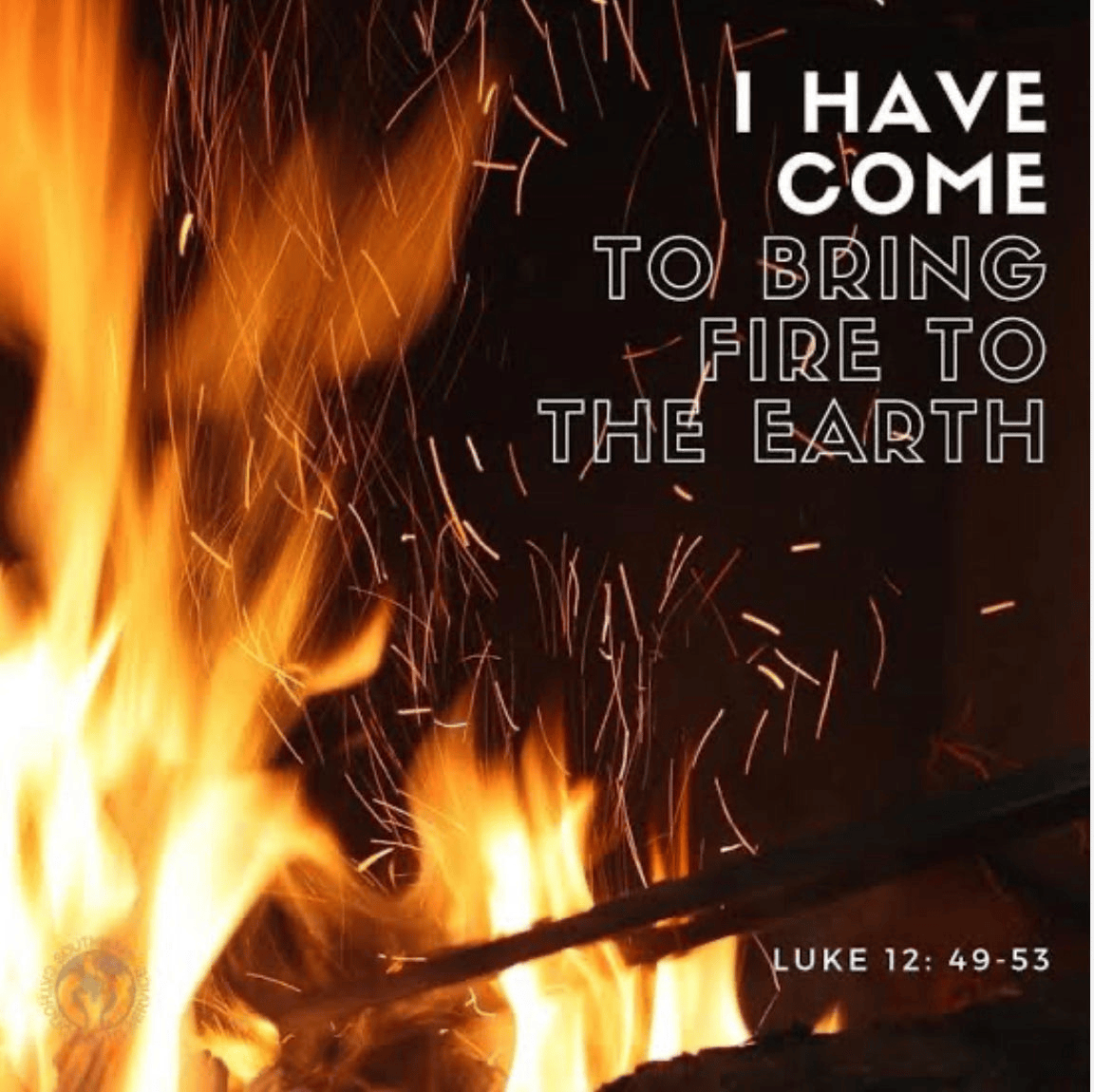
Jesus’ Request to You and Me

Daily Reflection – 10/22/2026

Sacred Scripture

Jesus said to his disciples: “I have come to set the earth on fire, and how I wish it were already blazing! There is a baptism with which I must be baptized, and how great is my anguish until it is accomplished! Do you think that I have come to establish peace on the earth? No, I tell you, but rather division. From now on a household of five will be divided, three against two and two against three; a father will be divided against his son and a son against his father, a mother against her daughter and a daughter against her mother, a mother-in-law against her daughter-in-law and a daughter-in-law against her mother-in-law.” (Luke 12:49-53)

Reflection

The Jesus we encounter in today’s Gospel is not the gentle, predictable figure many people prefer. Instead, He speaks of fire, anguish, sacrifice, and division. These words can make us uncomfortable because they challenge the version of Christianity we often try to create for ourselves: one that asks little, costs little, and disrupts little.

Jesus came to set the earth on fire. This is not a fire of destruction but a fire of transformation. It is the fire of God’s love, truth, and holiness. Fire changes whatever it touches. It purifies gold, consumes impurities, and gives warmth and light. Jesus desires that same transforming fire to burn within our hearts.

The difficulty is that many of us want the warmth of the fire without allowing it to change us. We want the comfort of faith, but not always the sacrifice. We appreciate Jesus as Savior, but are less eager to accept Him as Lord. We welcome the promises of heaven while resisting the demands of discipleship.

The Gospel reminds us that following Christ requires a decision. Neutrality is rarely an option. When Jesus becomes the center of our lives, priorities change. Values change. Sometimes relationships even become strained because the path of faith does not always align with the values of the world. The division Jesus speaks about is not one He desires for its own sake. Rather, it is the natural consequence of choosing truth in a world that often prefers convenience.

Many people spend their lives avoiding discomfort. We avoid difficult conversations, difficult sacrifices, and difficult truths. Yet Christ never promised comfort as the highest goal. He promised life, and that life comes through surrender, trust, and perseverance. The road to Calvary always comes before the empty tomb.

What stands out in this passage is Jesus’ own determination. He speaks of the baptism He must undergo, referring to His suffering and death. He knows what awaits Him, yet He moves forward. His commitment to the Father’s will is absolute. This same Lord now invites us to follow Him with courage and conviction.

The question for us is simple: Is our faith merely a comforting addition to our lives, or is it a consuming fire that shapes every part of who we are? Jesus does not seek fans who admire Him from a safe distance. He seeks disciples willing to walk with Him, trust Him, and allow His love to transform them.

May we remove the asbestos around our hearts and allow the fire of Christ to burn brightly within us. The cost may be high, but the reward is greater still. There is no life more meaningful than one surrendered to Him.

Prayer of The Day

“Lord Jesus, You came to set the world ablaze with the fire of Your love and truth. Burn away the fear, complacency, and selfishness that keep me from following You completely. Give me the courage to stand firm in faith when discipleship is difficult and the strength to persevere when the road is challenging. May my heart be fully Yours, and may Your love shine through my words and actions each day. Amen.”

Daily Note

Today’s Gospel challenges me to examine whether I have settled for a comfortable faith. Christ does not call me merely to believe in Him, but to follow Him wholeheartedly. Whenever truth, integrity, and faithfulness require sacrifice, I must remember that the Lord Himself walked that path first. The fire of discipleship may be costly, but it leads to a deeper relationship with Christ and ultimately to eternal life.
More Than We Know

Daily Reflection – 10/21/2026

Sacred Scripture

Jesus said to his disciples: “Be sure of this: if the master of the house had known the hour when the thief was coming, he would not have let his house be broken into. You also must be prepared, for at an hour you do not expect, the Son of Man will come.” Then Peter said, “Lord, is this parable meant for us or for everyone?” And the Lord replied, “Who, then, is the faithful and prudent steward whom the master will put in charge of his servants to distribute the food allowance at the proper time? Blessed is that servant whom his master on arrival finds doing so. Truly, I say to you, he will put him in charge of all his property. But if that servant says to himself, ‘My master is delayed in coming,’ and begins to beat the menservants and the maidservants, to eat and drink and get drunk, then that servant’s master will come on an unexpected day and at an unknown hour and will punish the servant severely and assign him a place with the unfaithful. That servant who knew his master’s will but did not make preparations nor act in accord with his will shall be beaten severely; and the servant who was ignorant of his master’s will but acted in a way deserving of a severe beating shall be beaten only lightly. Much will be required of the person entrusted with much, and still more will be demanded of the person entrusted with more.” (Luke 12:39-48)

Reflection

Most people do not see themselves as particularly important. We tend to measure significance by fame, influence, wealth, or the number of people who know our name. By those standards, many of us assume our lives are small and largely unnoticed.

Jesus offers a very different perspective.

In today’s Gospel, He speaks about servants entrusted with responsibility while awaiting their master’s return. The message is clear: what matters is not how visible we are, but how faithful we are. The master does not reward the servant for being impressive. He rewards the servant for being trustworthy.

That can be an uncomfortable truth because it reminds us that each of us has been given something by God. We have been entrusted with time, relationships, gifts, opportunities, and faith itself. None of these are accidental. They are part of God’s plan for our lives. Whether we recognize it or not, people are affected by the way we live, speak, serve, forgive, and love.

When Jesus says that much will be required of those entrusted with much, He is not trying to frighten us. Rather, He is revealing how much confidence God has placed in us. God sees possibilities within us that we often fail to see ourselves.

Yet many of us hesitate. We tell ourselves we are too busy, too tired, too discouraged, or too ordinary to make a difference. We imagine that building God’s Kingdom is work reserved for saints, missionaries, or extraordinary people.

But the Kingdom is usually built in ordinary moments.

It is built when a parent chooses patience over anger. It is built when someone offers encouragement instead of criticism. It is built when we notice the person who is lonely, forgive someone who has hurt us, or make time to help another person carry a burden.

Faithfulness rarely arrives in dramatic ways. More often it appears in small acts of love repeated day after day.

The key is learning to see as Christ sees. When we recognize the beauty and worth of the people around us, serving them becomes more than an obligation. It becomes an act of love. The more we love, the more we become aware of Christ’s presence in our lives and in the lives of others.

Then today’s Gospel takes on a different meaning. Being prepared for the Lord’s return is not simply about waiting. It is about living every day with purpose, gratitude, and love. It is about using whatever God has entrusted to us for the good of others and the glory of God.

Your life matters more than you know. Your faithfulness matters more than you realize. And every act of love leaves a mark that reaches far beyond what you can see.

Prayer of The Day

“Lord Jesus, thank You for the gifts, opportunities, and people You have entrusted to my care. When I doubt my worth or question whether I can make a difference, remind me that You have called me to faithfulness, not greatness in the eyes of the world. Help me to recognize the beauty in those around me and to serve them with patience, kindness, and love. May I be ready whenever You call, living each day as a faithful steward of Your blessings. Amen.”

Daily Note

God does not measure our lives by prominence but by faithfulness. Every act of love, service, mercy, and patience helps build His Kingdom. Today, focus on the gifts God has entrusted to you and use them generously. The Lord sees every effort made in love, and nothing done for Him is ever wasted

Keep The Lamp Burning

Daily Reflection – 10/20/2026

Sacred Scripture

Jesus said to his disciples: “Gird your loins and light your lamps and be like servants who await their master’s return from a wedding, ready to open immediately when he comes and knocks. Blessed are those servants whom the master finds vigilant on his arrival. Amen, I say to you, he will gird himself, have them recline at table, and proceed to wait on them. And should he come in the second or third watch and find them prepared in this way, blessed are those servants.” Luke 12:35-38

Reflection

Jesus paints a powerful image in this passage: servants waiting through the night, lamps lit, eyes attentive, hearts ready for their master’s return. The emphasis is not on knowing when the master will arrive. Rather, it is on remaining faithful no matter how long the wait may be.

Faithfulness is often celebrated in theory but tested in practice. It is easy to promise commitment when the future appears bright and predictable. It is much harder to remain steadfast when prayers seem unanswered, when life takes unexpected turns, or when the rewards of discipleship are not immediately visible. Yet this is exactly the kind of vigilance Jesus commends.

The servants in the parable do not know whether the master will return during the first watch, the second, or the third. Their task is not to calculate his arrival but to be ready whenever it comes. In much the same way, we are called to live each day in a state of spiritual readiness. We do not know when God will call us to a new opportunity, a moment of service, a difficult challenge, or ultimately into His presence. Our responsibility is simply to remain faithful where we are.

What makes this passage especially beautiful is the surprising reward Jesus describes. The master does not merely thank the servants for their vigilance. He seats them at the table and serves them himself. In earthly terms, this would be unthinkable. Yet this is the heart of Christ. The Lord we serve is also the Lord who serves us. He strengthens us, nourishes us, forgives us, and accompanies us through every season of life.

Remaining vigilant, then, is not about living in fear or anxiety. It is about living in hope. A Christian does not spend life nervously watching the clock. A Christian keeps the lamp of faith burning through prayer, trust, acts of kindness, and perseverance. We stay ready by welcoming Christ into our daily lives and by becoming His presence for others.

Every day we encounter people carrying burdens we cannot see. Some are discouraged. Some are lonely. Some are quietly fighting battles that few understand. Our readiness for Christ is revealed by how willing we are to be His hands and feet to those around us. A word of encouragement, an act of compassion, or a listening ear may become the very knock of Christ at the door of another person’s heart.

The Lord continues to knock at our own hearts as well. He asks us to open the door immediately, trusting that whatever He brings into our lives is part of His loving plan. Blessed are those who keep their lamps burning and remain ready for His arrival.

Prayer of The Day

“The Lord continues to knock at our own hearts as well. He asks us to open the door immediately, trusting that whatever He brings into our lives is part of His loving plan. Blessed are those who keep their lamps burning and remain ready for His arrival.”

Daily Note

Vigilance is not about waiting with fear; it is about living with expectation. Every act of faithfulness, every prayer, every kindness keeps the lamp burning. Today, stay alert to the opportunities Christ places before you. The Lord who asks for your faithfulness is the same Lord who promises to strengthen and serve you along the journey

Rich In What Matters

Daily Reflection – 10/19/2026

Sacred Scripture

Someone in the crowd said to Jesus, “Teacher, tell my brother to share the inheritance with me.” He replied to him, “Friend, who appointed me as your judge and arbitrator?” Then he said to the crowd, “Take care to guard against all greed, for though one may be rich, one’s life does not consist of possessions.”

Then he told them a parable.

“There was a rich man whose land produced a bountiful harvest. He asked himself, ‘What shall I do, for I do not have space to store my harvest?’ And he said, ‘This is what I shall do: I shall tear down my barns and build larger ones. There I shall store all my grain and other goods and I shall say to myself, “Now as for you, you have so many good things stored up for many years, rest, eat, drink, be merry!”’

But God said to him, ‘You fool, this night your life will be demanded of you; and the things you have prepared, to whom will they belong?’

Thus will it be for the one who stores up treasure for himself but is not rich in what matters to God.” (Luke 12:13-21)

Reflection

The rich man’s fault was not that he planned ahead. There is wisdom in preparing for tomorrow and using responsibly what God has placed in our hands. His mistake was that his plans began and ended with himself. His harvest, his barns, his possessions, his comfort and his future became the whole horizon of his life. There was no room for his neighbor, and ultimately, no room for God.

Jesus reminds us that our lives cannot be measured by what we possess.

Everything we have begins as a gift. Our lives are gifts from God. Our abilities, opportunities, relationships and material blessings are gifts. Even the breath we take at this moment is something we did not create for ourselves.

Recognizing life as gift changes the question from, “How much can I keep?” to, “How can I use what I have been given for good?”

The rich man kept building larger barns, but his heart was becoming smaller. His wealth increased, but the richness of his life did not. He knew how to accumulate, but he had forgotten how to share. He prepared carefully for his earthly future, yet he neglected the condition of his soul.

That is the danger of greed. It convinces us that having more will make us secure. Yet possessions cannot give us the security that comes from knowing and trusting God. Material things can serve us, but they cannot save us.

Our relationship with God should therefore be rooted in thanksgiving. When we understand how much we have received, gratitude naturally turns us outward. We begin to recognize that other people are not competitors for what belongs to us. They are our brothers and sisters, people whose burdens and needs matter to God and therefore must matter to us.

This Gospel also invites us to examine what our society teaches us to value. When wealth, possessions, status or economic success become the ultimate measure of a person’s worth, something precious is lost. Human life is worth more than anything that can be bought, accumulated or stored away.

One day, like the rich man in Jesus’ parable, every one of us will leave behind everything we have accumulated. We will not take our houses, bank accounts, accomplishments or possessions with us.

What remains is the life we lived before God.

Did we love? Did we give? Did we recognize God’s blessings with gratitude? Did we make room at our table for somebody else? Did we use what God entrusted to us only to build bigger barns, or did we use those gifts to build a bigger heart?

To be “rich in what matters to God” is to live with gratitude, generosity, compassion and love. It is to understand that the greatest treasure is not what we possess, but the person we become through our relationship with God and with one another.

Prayer of The Day

“Lord Jesus, free my heart from greed, possessiveness and the desire to find security in material things. Teach me to recognize everything I have as a gift from You. Give me a grateful heart and a generous spirit so that I may use Your blessings not only for myself, but also for the good of others.

Help me to desire You above every earthly treasure. Teach me to build my life around what matters to You: faith, compassion, generosity, justice and love. And when I am tempted to build bigger barns for myself, remind me instead to build a bigger heart. Amen.”

Daily Note

The Kingdom of God is not built by what we accumulate, but by what we are willing to give. The rich man filled his barns but left his heart empty. Jesus asks us to choose another way: to receive God’s gifts with gratitude, share them generously and place our security in God rather than in possessions.

Today, ask yourself: “Am I building bigger barns, or am I building a bigger heart?”

That may be the treasure we carry into eternity.

Are We Listening Today?

Daily Ref lection – 10/16/2026

Sacred Scripture

Woe to you! for you build the tombs of the prophets whom your fathers killed. So you are witnesses and consent to the deeds of your fathers; for they killed them, and you build their tombs. Therefore also the Wisdom of God said, `I will send them prophets and apostles, some of whom they will kill and persecute,’ that the blood of all the prophets, shed from the foundation of the world, may be required of this generation, from the blood of Abel to the blood of Zechariah, who perished between the altar and the sanctuary. Yes, I tell you, it shall be required of this generation. Woe to you lawyers! for you have taken away the key of knowledge; you did not enter yourselves, and you hindered those who were entering.” As he went away from there, the scribes and the Pharisees began to press him hard, and to provoke him to speak of many things, lying in wait for him, to catch at something he might say. (Luke 11:47-54)

Reflection

There is something deeply ironic in today’s Gospel.

Jesus tells the religious leaders that they build monuments to the prophets their ancestors killed. They honor the memory of God’s messengers, decorate their tombs, and speak respectfully of their sacrifices. Yet standing right in front of them is the Son of God Himself, and they are already plotting how to silence Him.

The tragedy is obvious to us because we know the ending.

But perhaps the lesson is not about them.

Perhaps it is about us.

Most of us imagine that if we had lived in biblical times, we would have listened to the prophets. We would have welcomed Jesus. We would have stood with the saints and defended the truth. Yet history suggests a different reality. God’s messengers are rarely rejected because people fail to recognize their words. They are rejected because their words demand change.

We love prophets after they are gone because they no longer challenge us.

It is easy to admire St. Francis, but harder to embrace simplicity when we are attached to our comforts. It is easy to praise Mother Teresa, but harder to love the difficult person who crosses our path today. It is easy to honor the courage of the apostles, but harder to speak openly about our faith when doing so risks discomfort or criticism.

The truth is that God does not usually speak to us through dramatic signs or voices from heaven. Most often He speaks through ordinary moments. A guilty conscience that tells us to make things right. A difficult conversation we know we need to have. A call to forgive when we would rather remain angry. A nudge to trust Him when fear seems more reasonable.

The question is not whether we would have listened to yesterday’s prophets.

The question is whether we are listening to God today.

The Pharisees could see the tombs of the prophets. What they could not see was their own resistance. They believed they were defenders of truth while fighting against the very Truth standing before them.

That should humble every one of us.

It is possible to attend church regularly and still resist God. It is possible to know Scripture and still ignore the lesson He wants to teach us. It is possible to praise holiness in others while avoiding it ourselves.

The challenge of this Gospel is not merely to admire the courage of the prophets. It is to recognize where God is speaking in our lives right now and have the courage to respond.

One day, future generations may tell stories about men and women who faithfully followed Christ in difficult times. The real question is whether we are willing to become part of that story.

God is still speaking.

May we not be so busy honoring yesterday’s voices that we fail to hear His voice today.

Prayer of The Day

“Lord Jesus, give me a listening heart. Remove the pride that keeps me from hearing the truths I need most. Help me recognize Your voice in the ordinary moments of my day and give me the courage to respond with faith. May I not simply admire holiness from a distance, but strive to live it in my own life. Lead me closer to You, and help me follow wherever You call. Amen.”

Daily Note

God’s voice is not confined to the pages of history. He still speaks through circumstances, relationships, prayer, and conscience. Today, be attentive. The invitation you need to hear may already be right in front of you.

The Prophets We Praise and the Truth We Resist

Daily Reflection – 10/15/2026

Sacred Scripture

Woe to you! for you build the tombs of the prophets whom your fathers killed. So you are witnesses and consent to the deeds of your fathers; for they killed them, and you build their tombs. Therefore also the Wisdom of God said, `I will send them prophets and apostles, some of whom they will kill and persecute,’ that the blood of all the prophets, shed from the foundation of the world, may be required of this generation, from the blood of Abel to the blood of Zechariah, who perished between the altar and the sanctuary. Yes, I tell you, it shall be required of this generation. Woe to you lawyers! for you have taken away the key of knowledge; you did not enter yourselves, and you hindered those who were entering.” As he went away from there, the scribes and the Pharisees began to press him hard, and to provoke him to speak of many things, lying in wait for him, to catch at something he might say. (Luke 11:47-54)

Reflection

There is something deeply ironic in today’s Gospel.

Jesus tells the religious leaders that they build monuments to the prophets their ancestors killed. They honor the memory of God’s messengers, decorate their tombs, and speak respectfully of their sacrifices. Yet standing right in front of them is the Son of God Himself, and they are already plotting how to silence Him.

The tragedy is obvious to us because we know the ending.

But perhaps the lesson is not about them.

Perhaps it is about us.

Most of us imagine that if we had lived in biblical times, we would have listened to the prophets. We would have welcomed Jesus. We would have stood with the saints and defended the truth. Yet history suggests a different reality. God’s messengers are rarely rejected because people fail to recognize their words. They are rejected because their words demand change.

We love the prophets after they are gone because they no longer challenge us.

It is easy to admire St. Francis, but harder to embrace simplicity when we are attached to our comforts. It is easy to praise Mother Teresa, but harder to love the difficult person who crosses our path today. It is easy to honor the courage of the apostles, but harder to speak openly about our faith when doing so risks discomfort or criticism.

The truth is that God does not usually speak to us through dramatic signs or voices from heaven. Most often He speaks through ordinary moments. A guilty conscience that tells us to make things right. A difficult conversation we know we need to have. A call to forgive when we would rather remain angry. A nudge to trust Him when fear seems more reasonable.

The question is not whether we would have listened to yesterday’s prophets.

The question is whether we are listening to God today.

The Pharisees could see the tombs of the prophets. What they could not see was their own resistance. They believed they were defenders of truth while fighting against the very Truth standing before them.

That should humble every one of us.

It is possible to attend church regularly and still resist God. It is possible to know Scripture and still ignore the lesson He wants to teach us. It is possible to praise holiness in others while avoiding it ourselves.

The challenge of this Gospel is not merely to admire the courage of the prophets. It is to recognize where God is speaking in our lives right now and have the courage to respond.

One day, future generations may tell stories about men and women who faithfully followed Christ in difficult times. The real question is whether we are willing to become part of that story.

God is still speaking.

May we not be so busy honoring yesterday’s voices that we fail to hear His voice today.

Prayer of The Day

“Lord Jesus, give me a listening heart. Remove the pride that keeps me from hearing the truths I need most. Help me recognize Your voice in the ordinary moments of my day and give me the courage to respond with faith. May I not simply admire holiness from a distance, but strive to live it in my own life. Lead me closer to You, and help me follow wherever You call. Amen.”

Daily Note

God’s voice is not confined to the pages of history. He still speaks through circumstances, relationships, prayer, and conscience. Today, be attentive. The invitation you need to hear may already be right in front of you.

Beyond Appearances

Daily Reflection – 10/14/2026

Beyond Appearances

Sacred Scripture

The Lord said: “Woe to you Pharisees! You pay tithes of mint and of rue and of every garden herb, but you pay no attention to judgment and to love for God. These you should have done, without overlooking the others. Woe to you Pharisees! You love the seat of honor in synagogues and greetings in marketplaces. Woe to you! You are like unseen graves over which people unknowingly walk.” Then one of the scholars of the law said to him in reply, “Teacher, by saying this you are insulting us too.” And he said, “Woe also to you scholars of the law! You impose on people burdens hard to carry, but you yourselves do not lift one finger to touch them.” (Luke 11:42-46)

Reflection

The words of Jesus in this passage are uncomfortable, and that is precisely why they deserve our attention. His criticism of the Pharisees and scholars of the law is not directed at their religious practices themselves. In fact, He acknowledges that some of the things they do are good. They tithe carefully and observe religious obligations faithfully. The problem is that they have become so focused on the appearance of holiness that they have neglected the heart of it.

Jesus points to a painful contradiction. They are meticulous about small details while overlooking judgment, mercy, and love for God. Outwardly, they appear devoted. Inwardly, something is missing. Their religion has become more concerned with recognition than transformation.

This warning is not limited to religious leaders from two thousand years ago. It is a warning for every believer. It is possible to attend Mass, say prayers, serve in ministry, and be known as a person of faith while still failing to love as Christ loves. We can become experts at appearing faithful while avoiding the harder work of allowing God to change our hearts.

The scholars of the law receive an equally strong rebuke. They place heavy burdens on others but offer no help in carrying them. They demand much while giving little. Jesus reveals that authentic leadership is never about making life harder for others. True leadership serves, encourages, and helps shoulder burdens. This applies not only in religious settings but also in our homes, workplaces, friendships, and communities.

It is easy to criticize others for falling short. It is much harder to walk beside them with patience and compassion. Jesus Himself never asked people to carry a burden He was unwilling to bear. He entered fully into our struggles, our pain, and ultimately our suffering. The cross stands as the ultimate proof that Christ practices what He preaches.

Perhaps the most challenging question from this Gospel is simple: Do my actions make it easier or harder for others to draw closer to God? Sometimes, without realizing it, we can become judgmental, demanding, or impatient. We can expect perfection from others while excusing our own weaknesses. When that happens, we begin to resemble the very people Jesus rebukes.

The antidote is humility. Humility keeps us honest about our own need for God’s mercy. It reminds us that faith is not about earning admiration but about becoming more loving. The more we recognize how generously God has treated us, the more willing we become to extend that same generosity to others.

Today, Jesus invites us to examine our hearts. Not simply what we do, but why we do it. Not simply whether we follow the rules, but whether love motivates our obedience. The Gospel is not measured by appearances. It is measured by a heart transformed by God’s grace and a life that helps others carry their burdens rather than adding to them.

Prayer of The Day

“Lord Jesus, protect me from the temptation of outward religion without inward conversion. Help me to live what I profess and to love what You love. Give me a humble heart that seeks Your approval rather than the praise of others. Teach me to notice the burdens carried by those around me and to help lift them with kindness, patience, and compassion. May my words, actions, and attitudes lead others closer to You. Amen.”

Daily Note

True cleansing begins within. Rituals have value only when they reflect a heart already surrendered to God. The Gospel calls every believer to daily interior examination — not to perform faith, but to embody it. When our actions flow from a heart shaped by mercy, humility, and compassion, our witness becomes authentic, and our faith becomes alive.

The Heart That God Sees

Daily Reflection – 10/13/2026

Sacred Scripture

“After Jesus had spoken, a Pharisee invited him to dine at his home. He entered and reclined at table to eat. The Pharisee was amazed to see that he did not observe the prescribed washing before the meal. The Lord said to him, ‘Oh you Pharisees! Although you cleanse the outside of the cup and the dish, inside you are filled with plunder and evil. You fools! Did not the maker of the outside also make the inside? But as to what is within, give alms, and behold, everything will be clean for you.’” (Luke 11:37–41)

Reflection

Jesus’ decision to skip the ceremonial washing wasn’t meant to offend His host — it was meant to reveal something deeper. In a moment that surprised the Pharisee, Jesus gently showed that God is far more concerned with the condition of the heart than the appearance of religious practice. His words invite us into honesty, authenticity, and a faith that grows from the inside out.

This passage challenges us to consider whether our spiritual life is rooted in genuine transformation or in outward habit. It’s easy to look the part of a believer: attending church, participating in worship, following tradition. But Jesus reminds us that true holiness is not measured by what others see — it is measured by what God sees within us.

The Pharisees excelled at external devotion, yet their hearts remained untouched by mercy and compassion. Jesus uses the image of a cup: polished on the outside, neglected on the inside. It’s a vivid reminder that faith is not a performance. It is a conversion of the heart.

Jesus then turns to almsgiving — not simply as charity, but as a sign of interior renewal. When we give to those in need, we make room for compassion, kindness, and humility. These virtues crowd out bitterness, envy, and self‑righteousness. Generosity reshapes the heart in ways ritual never can.

Throughout ministry, many have embraced the comfort of religious routine without allowing the Gospel to reshape their lives. They evaluate others, critique others, and measure others, while ignoring the planks in their own eyes. Such judgment drains the soul and distorts the witness of faith.

The love of Jesus is the remedy. His love is patient, tender, and cleansing. When His love becomes the love that beats within us, our interior life begins to match our outward witness. Peace follows. Integrity follows. Authenticity follows.

In the end, God will not examine how polished our rituals were — He will examine how transformed our hearts became. When the inside is clean, the outside naturally reflects His goodness. This is the heart that God sees.

Prayer of The Day

“Lord Jesus, fill me with your love and increase my thirst for holiness. Cleanse my heart of every evil thought and desire, and help me to act kindly, speak charitably, and live justly toward my neighbor.”

Daily Note

True cleansing begins within. Rituals have value only when they reflect a heart already surrendered to God. The Gospel calls every believer to daily interior examination — not to perform faith, but to embody it. When our actions flow from a heart shaped by mercy, humility, and compassion, our witness becomes authentic, and our faith becomes alive.

Dressed For The Invitation

Daily Reflection – 10/12/2026

Sacred Scripture

Jesus again in reply spoke to them in parables, saying, “The Kingdom of heaven may be likened to a king who gave a wedding feast for his son. He dispatched his servants to summon the invited guests to the feast, but they refused to come. A second time he sent other servants, saying, ‘Tell those invited: “Behold, I have prepared my banquet, my calves and fattened cattle are killed, and everything is ready; come to the feast.”’ Some ignored the invitation and went away, one to his farm, another to his business. The rest laid hold of his servants mistreated them, and killed them. The king was enraged and sent his troops, destroyed those murderers, and burned their city. Then he said to his servants, ‘The feast is ready, but those who were invited were not worthy to come. Go out, therefore, into the main roads and invite to the feast whoever you find.’ The servants went out into the streets and gathered all they found, bad and good alike, and the hall was filled with guests. But when the king came in to meet the guests, he saw a man there not dressed in a wedding garment. He said to him, ‘My friend, how is it that you came in here without a wedding garment?’ But he was reduced to silence. Then the king said to his attendants, ‘Bind his hands and feet, and cast him into the darkness outside, where there will be wailing and grinding of teeth.’ Many are invited, but few are chosen.” (Matthew 22:1-14)

Reflection

One of the most striking details in this parable is that the feast is already prepared before anyone responds. The king has done the work. The banquet is ready. The invitation has been sent. The only question is whether people will come.

Jesus tells us that many of those originally invited had perfectly ordinary reasons for refusing. One went to his farm. Another went to his business. These were not necessarily evil pursuits. They were simply things that became more important than the invitation itself. That is often how our relationship with God is challenged. Rarely do we reject Him outright. More often, we become distracted. We tell ourselves we will make time for prayer later, serve others later, deepen our faith later. Meanwhile, the invitation sits unanswered.

The king’s response is astonishing. He does not cancel the feast. Instead, he widens the invitation. The roads are searched, and everyone is welcomed, both good and bad alike. This is a beautiful image of God’s heart. His desire is not to exclude but to gather. His kingdom is not reserved for a select group of perfect people. It is offered to anyone willing to accept His call.

Yet the parable does not end there. A guest arrives without a wedding garment. This can seem harsh at first, but the deeper message is that accepting the invitation is only the beginning. God does not merely invite us to attend. He invites us to be transformed.

The wedding garment represents a life that has responded to grace. It symbolizes the outward expression of an inward commitment. We cannot claim to accept God’s invitation while refusing to let Him change us. Faith is not simply acknowledging God’s existence. It is allowing His love to shape our attitudes, our choices, and our treatment of others.

This is where the Gospel speaks directly to our daily lives. Every morning God extends another invitation. He invites us to forgive instead of holding resentment. He invites us to be patient when we are frustrated, generous when we are tired, and compassionate when it would be easier to walk away. The wedding garment is woven from these everyday acts of discipleship.

The good news is that God does not ask us to create this garment on our own. Through prayer, the sacraments, Scripture, and the support of other believers, He continually provides the grace needed to become the people He calls us to be.

The invitation has already been delivered. The banquet is waiting. The question each of us must answer is not whether we received the invitation, but whether we are willing to put on Christ and live as His disciples. The kingdom is open to all, but it is entered by those who allow God’s love to transform their hearts.

Prayer of The Day

“Lord Jesus, thank You for inviting me to share in the joy of Your kingdom. Help me never to take Your invitation for granted. Remove anything that keeps me distracted from You and clothe me with the garment of faith, love, humility, and obedience. May my words and actions reflect the life You have given me, so that I may joyfully walk with You every day and one day share fully in Your heavenly banquet. Amen.”

Daily Note

God’s invitation is renewed each day. We honor that invitation not simply by believing, but by living as disciples in ordinary moments of life. Today, ask yourself: Am I merely attending the banquet, or am I truly wearing the garment of Christ?

The House That We Choose

Daily Reflection – 10/09/2026

Sacred Scripture

When Jesus had driven out a demon, some of the crowd said, “By the power of Beelzebul, the prince of demons, he drives out demons.” Others, to test him, asked him for a sign from heaven. But he knew their thoughts and said to them, “Every kingdom divided against itself will be laid waste and house will fall against house. And if Satan is divided against himself, how will his kingdom stand? For you say that it is by Beelzebul that I drive out demons. If I, then, drive out demons by Beelzebul, by whom do your own people drive them out? Therefore they will be your judges. But if it is by the finger of God that I drive out demons, then the Kingdom of God has come upon you. When a strong man fully armed guards his palace, his possessions are safe. But when one stronger than he attacks and overcomes him, he takes away the armor on which he relied and distributes the spoils. Whoever is not with me is against me, and whoever does not gather with me scatters. When an unclean spirit goes out of someone, it roams through arid regions searching for rest but, finding none, it says, ‘I shall return to my home from which I came.’ But upon returning, it finds it swept clean and put in order. Then it goes and brings back seven other spirits more wicked than itself who move in and dwell there, and the last condition of that person is worse than the first.”( Luke 11:15-26)

Reflection

Today’s Gospel speaks directly to one of the greatest spiritual challenges of our time: not the presence of evil, but our tendency to underestimate its influence while overestimating our own ability to remain neutral.

After Jesus drives out a demon, some people refuse to celebrate the miracle. Instead, they accuse Him of being allied with evil. Their hearts are so clouded by suspicion, pride, and prejudice that they cannot recognize God’s work standing right in front of them. Rather than allowing the miracle to change them, they search for reasons to dismiss it.

It is tempting to think that such spiritual blindness belonged only to the Pharisees, but the truth is far more uncomfortable. We can fall into the same trap. We can become so attached to our opinions, expectations, and assumptions that we fail to recognize God’s presence when He works in ways we did not anticipate.

Our modern world does not make this easier. We live in an age of endless noise. Opinions compete with facts. Anger often speaks louder than wisdom. People draw lines, choose sides, and sometimes refuse to listen to anyone who thinks differently. In such an environment, it becomes increasingly difficult to discern what is true, good, and of God.

Jesus responds to His critics with a simple but powerful truth: a kingdom divided against itself cannot stand. His mission is not to create confusion but to bring healing, restoration, and unity. Everything He does points toward the Kingdom of God.

Then Jesus moves beyond the argument and addresses the deeper spiritual reality. He speaks about an unclean spirit leaving a person, only to return later and find the house clean but empty. The danger was not that the house remained dirty; the danger was that it remained vacant.

That image speaks volumes. Many people focus on removing negative habits, sinful behaviors, or destructive influences from their lives. While that is important, Jesus teaches that removing darkness is only half the battle. The empty space must be filled with something greater. If not, the soul becomes vulnerable once again.

Saint Augustine famously observed that every human heart contains a space that only God can fill. We often try to fill that space with success, possessions, distractions, accomplishments, relationships, or personal achievements. Yet none of these can satisfy the deepest hunger of the soul. Only God can truly occupy the house He created.

The Gospel forces us to ask a challenging question: Who sits on the throne of my heart?

Jesus makes it clear that neutrality is an illusion. “Whoever is not with me is against me.” His words are not meant to threaten but to awaken. Every day we are making choices that either gather with Christ or scatter from Him. We are either inviting Him to take deeper possession of our lives or leaving parts of ourselves closed off from His grace.

The good news is that we are not left to fight spiritual battles alone. Christ overcomes every force that opposes us. When we welcome Him into our hearts through prayer, Scripture, worship, and acts of love, He strengthens us from within. The house of our soul is no longer empty. It becomes His dwelling place.

Today’s Gospel reminds us that faith is not merely about avoiding evil. It is about actively filling our lives with the presence of Jesus. When Christ occupies the house, fear loses its power, confusion gives way to clarity, and the soul finds the peace it has been seeking all along.

Prayer of The Day

“Lord Jesus, fill every room of my heart with Your presence. Help me recognize Your work in my life and trust in Your truth. Protect me from spiritual blindness, and give me the courage to choose You each day. May my heart never be empty, but always be a dwelling place for Your love. Amen.”

Daily Note

Removing negativity from our lives is not enough. We must replace it with prayer, gratitude, kindness, and God’s Word. An occupied heart is a protected heart. Invite Jesus into every part of your life today and allow Him to be the true ruler of your inner house.